SIS

Journal of Projective Psychology & Mental Health

International Peer-Reviewed Publication • Semiannual • Published from Medina, Ohio, USA

SIS Journal
Projective Psychology Portal
★ Authoritative Clinical Monograph • 700+ Pages

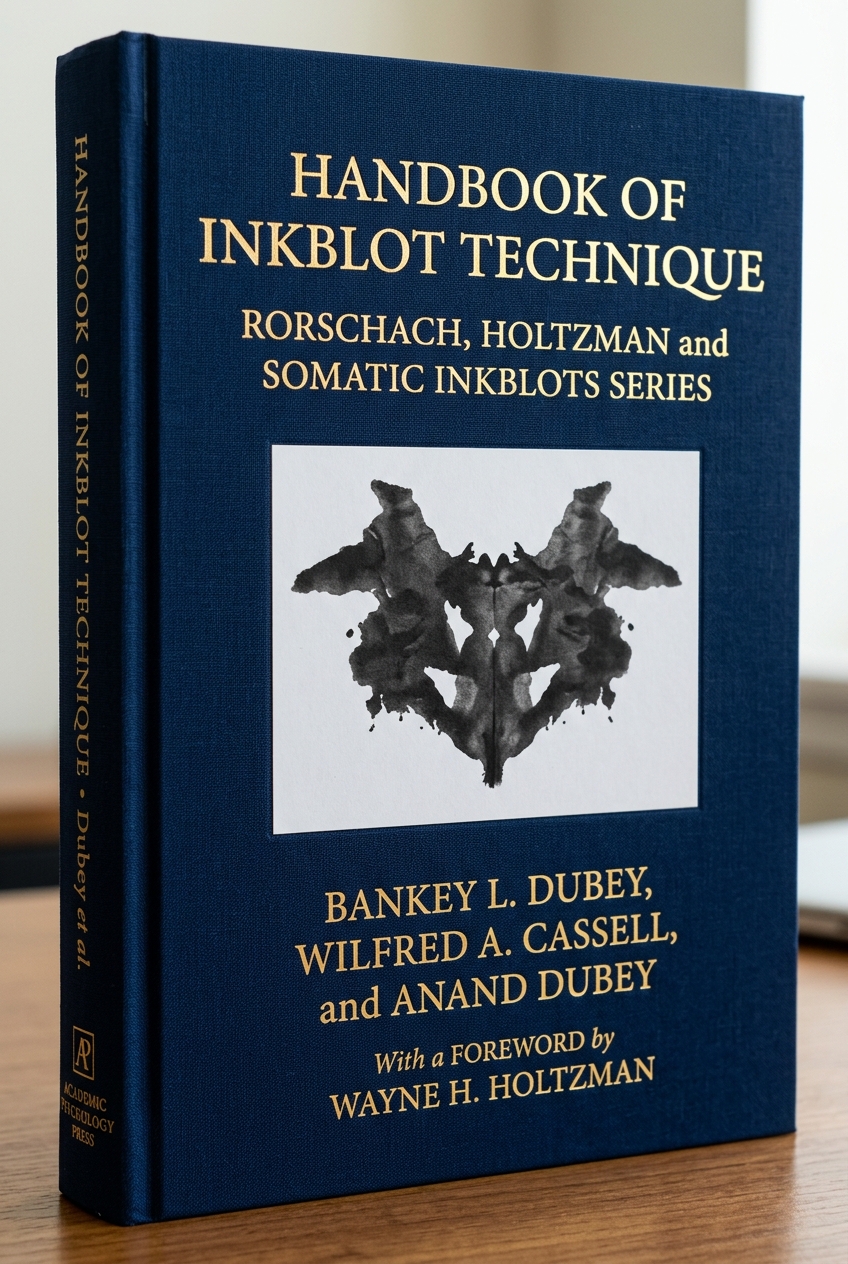
Handbook of Inkblot Technique

Rorschach, Holtzman and Somatic Inkblots Series

The monumental reference treatise bridging classical projective psychometrics with 21st-century psychosomatics, body boundary theory (Barrier / Penetration), cross-cultural empirical normative tables, and 25 comprehensive clinical case studies.

Authors:
Bankey L. Dubey, Ph.D., D.M.S.P.
Former Prof. Panjab Univ., Past Pres. IACP
Wilfred A. Cassell, M.D., FAPA
Creator of SIS, Director SIS Center
Anand Dubey, B.E., MBA, FSIS
MD Dubey Business Services, Editor SIS
Foreword by: Wayne H. Holtzman, Ph.D. (Hogg Professor Emeritus, Creator of HIT, Univ. of Texas at Austin)
Open Interactive Web Reader 📖 Explore 12 Chapters 🔬 25 Clinical Cases
Handbook of Inkblot Technique Book Cover
Bibliographic Citation
Dubey, B. L., Cassell, W. A., & Dubey, A. (2026). Handbook of Inkblot Technique: Rorschach, Holtzman and Somatic Inkblots Series. SIS Press.
Take SIT-30 Online →
Distinguished Foreword

Wayne H. Holtzman, Ph.D.

Hogg Professor Emeritus of Psychology, Past President of Hogg Foundation for Mental Health, University of Texas at Austin; Creator of the Holtzman Inkblot Technique (HIT).

“The authors have compiled a comprehensive, up-to-date handbook on inkblot tests as the most important projective techniques for assessing personality... The Somatic Inkblot Series deserves much greater attention from clinicians and researchers everywhere, and this handbook will help to acquaint them with the attractive features and both research and clinical possibilities of the Somatic Inkblot Series I and II.”
Read Full Foreword →
Author's Preface

Wilfred A. Cassell, M.D., FAPA

Creator of the Somatic Inkblot Series; Director of the SIS Center, Anchorage, Alaska; Fellow of the American Psychiatric Association.

“Prepare for an intellectual adventure into the methodologically illusive, inner realms of the ‘mind/body’... A unique advantage of the SIS procedure is that it bridges physiological body boundary defenses, yoga introspective awareness, and the unconscious cry for somatic healing.”
Read Full Author's Preface →

Handbook Table of Contents

12 comprehensive chapters covering historical roots, scoring methodology, empirical norms, and therapeutic application.

Front Matter 48 min read • 10,577 words

Front Matter

Title Page, Foreword, Preface & Contents

Read Chapter → SIT Protocol
Chapter 1 7 min read • 1,503 words

Hermann Rorschach: An Introduction

Hermann Rorschach – Artist and Creator of Inkblots

Read Chapter → SIT Protocol
Chapter 2 42 min read • 9,295 words

Historical Development of Inkblot Techniques

Evolution of Rorschach, Holtzman, and the Somatic Inkblot Series

Read Chapter → SIT Protocol
Chapter 3 34 min read • 7,481 words

Theoretical Postulates of Inkblot Tests

Percept Analysis, Somatic Imagery Theory, and Body Symbolism

Read Chapter → SIT Protocol
Chapter 4 140 min read • 30,886 words

Studies on Rorschach, Holtzman, and SIS in India

Empirical Research, Cross-Cultural Comparisons, and Clinical Studies

Read Chapter → SIT Protocol
Chapter 5 38 min read • 8,345 words

Administration and Scoring of Rorschach

Standard Administration, Klopfer, Beck, and Exner Comprehensive Systems

Read Chapter → SIT Protocol
Chapter 6 23 min read • 5,086 words

Administration, Scoring, and Interpretation of Holtzman Inkblot Test

The HIT 45-Card Parallel Forms and 22 Scoring Variables

Read Chapter → SIT Protocol
Chapter 7 30 min read • 6,623 words

Administration and Scoring of Somatic Inkblot Series

Standardized Administration, 11 Scoring Categories, Typical Percepts, and Pathological Scales

Read Chapter → SIT Protocol
Chapter 8 28 min read • 6,081 words

Quantitative and Indices-Based Interpretation

Klopfer Diagnostic Signs, Objective Scoring Indices, and Personality Clusters

Read Chapter → SIT Protocol
Chapter 9 10 min read • 2,143 words

Indian Norms and Diagnostic Indicators

Normative Database on Normal, Neurotic, Psychosomatic, and Psychotic Populations

Read Chapter → SIT Protocol
Chapter 10 10 min read • 2,134 words

Application of SIS in Business Organizations

Executive Assessment, Stress Tolerance, Team Dynamics, and Selection

Read Chapter → SIT Protocol
Chapter 11 546 min read • 120,149 words

Interpretation: Clinical Applications of Content Analysis

25 Landmark Clinical Case Studies Across Somatoform, Trauma, and Psychosomatic Disorders

Read Chapter → SIT Protocol
Chapter 12 95 min read • 20,823 words

Comprehensive Bibliography

International References, Monograph Citations, and Historical Literature

Read Chapter → SIT Protocol
Chapter 11 Spotlight

The 25 Landmark Clinical Case Studies

Comprehensive psychiatric and clinical content analyses across migraine, PTSD, somatization, sexual abuse, and body-boundary disintegration.

Case #1
Past Pain and Migraine:
3,709 words View Clinical Case →
Case #2
The Use of the Rorschach, SIS-I and SIS-II in Releasing Somatic Grief:
5,755 words View Clinical Case →
Case #3
Body Consciousness in Exhibitionism through Somatic Imagery:
5,530 words View Clinical Case →
Case #4
Unmasking the Devil with Projective Technique: Rorschach and Somatic Inkblots Series:
7,886 words View Clinical Case →
Case #5
The Adjunctive Use of SIS with Hypnotherapy:
4,359 words View Clinical Case →
Case #6
The SIS in Treating a Child with Panic Attacks during the Post-Divorce Period:
2,482 words View Clinical Case →
Case #7
A Case of Alopecia Areata:
1,173 words View Clinical Case →
Case #8
Rorschach and SIS in the Somatoform Disorders with Truth Serum Behavior Therapy:
4,422 words View Clinical Case →
Case #9
Inkblot Responses as an Aide to Therapy- A Longitudinal Case Study:
2,632 words View Clinical Case →
Case #10
Therapeutic Dream Stimulation through Inkblots Imagery:
4,956 words View Clinical Case →
Case #11
SIS-II in a Case of Sex Abuse and Somatic Pain:
1,714 words View Clinical Case →
Case #12
SIS Living Images in a Case of PTSD in Women:
6,576 words View Clinical Case →
Case #13
Symbolism in Violent Hallucination and Somatic Inkblots Imagery:
4,312 words View Clinical Case →
Case #14
SIS Detection of Invisible Imagery in Bipolar Affected Disorder:
4,465 words View Clinical Case →
Case #15
Therapeutic Processing of PTSD (Road Accident):
7,550 words View Clinical Case →
Case #16
Optimizing Spiritual Healing by Assessing Dream and SIS Imagery:
7,049 words View Clinical Case →
Case #17
SIS Cognitive Psychotherapy for Spouse Induced PTSD:
5,024 words View Clinical Case →
Case #18
Cognitive-Behavior Therapy with the SIS in Body Phobia:
1,742 words View Clinical Case →
Case #19
Assessing Suicidal/Homicidal Impulses with the SIS:
3,718 words View Clinical Case →
Case #20
Infectious Suicidal Imagery in Combat PTSD:
7,095 words View Clinical Case →
Case #21
SIS Imagery in Depression with Somatization – Therapeutic Intervention:
2,362 words View Clinical Case →
Case #22
SIS II-Video and Treatment of Alcoholism:
9,916 words View Clinical Case →
Case #23
Dissociative Convulsion Disorder - A Case Study:
1,833 words View Clinical Case →
Case #24
Somatic Inkblots imagery in Transsexual: A Case study.
1,380 words View Clinical Case →
Case #25
SIS Screening for Dangerous Impulses.
8,470 words View Clinical Case →

Ready to Administer the SIT 30 Test Online?

Experience the automated scoring engine, 11 standard categories, 18 Typical Percepts, and Pathological Scales described in this handbook.

Take SIT 30 Online → Read Chapter 7 (SIT Administration)
👀 5 Reading Now 🌍 140,524 Global Reach
👀 6 Reading Now 🌍 140,525 Global Reach
☕ Chip in $3 • Keep Science Open →